
AI Jobs Report
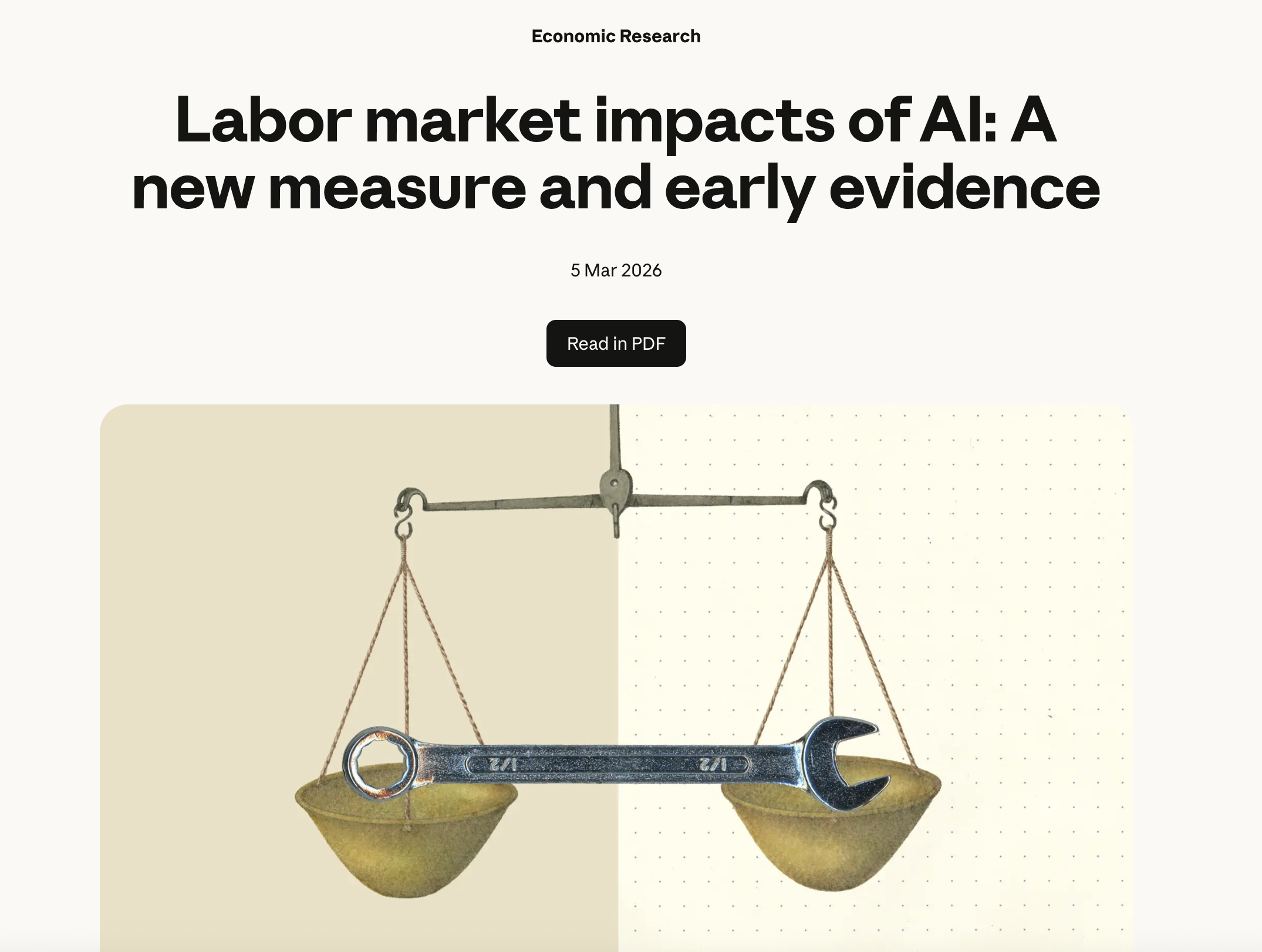
I read a lot of AI-and-jobs reports. Most tell you what you already fear. This one, from Anthropic (the company behind Claude), was different; it’s the first serious attempt I’ve seen to measure what AI is actually doing to employment, rather than what it theoretically could do.
Published in March, it’s worth a few minutes of your time. Here’s the short version, and what I think it means for us here in Ireland.
What Anthropic found
The researchers built a new measure they call “observed exposure”, essentially, how much of a job AI could theoretically do, versus how much it’s actually being used to do, right now, in the real world.
The headline finding: there’s roughly a 3x gap between the two. AI could theoretically handle a huge share of tasks in roles like computer programming, customer service and data entry. But actual usage is running well behind that ceiling.
The most exposed jobs are computer programmers, customer service representatives and data entry clerks. About 30% of workers, in roles like cooks, mechanics and bartenders, show almost no exposure at all.
And the big one: no clear rise in unemployment yet for workers in highly exposed roles. The one soft signal is that hiring of younger workers (22–25) into exposed occupations has slowed by around 14% since ChatGPT launched, not people losing jobs, but fewer new ones opening up for those starting out.
So, real change, but slower and quieter than the headlines suggest. Displacement by delay, not by dismissal.
What this means for Ireland
Anthropic’s data is US-based, but we don’t have to guess at the Irish picture; the ESRI and the Department of Finance published their own research on this in April, and it lands closer to home.
Their estimate: AI could displace around 7% of jobs in Ireland in the short-to-medium term, close to 200,000 roles. And here’s the part that should make every one of us sit up: unlike past waves of automation, this one hits highly educated, higher-earning workers hardest. ICT roles, clerical support and customer service clerks are most exposed. Physically demanding or customer-facing roles, like health professionals, tradespeople and agricultural workers, are far more insulated.
The part nobody’s headline mentions: what’s rising, not just what’s falling
Here’s where I’d point you to a third report, one that’s had far less press than the other two but might be the most useful of the lot: the World Economic Forum’s New Economy Skills: Unlocking the Human Advantage, published in December and a big talking point at Davos in January.
Where Anthropic and the ESRI measure what AI is replacing, this one asks the opposite question: what’s becoming more valuable because AI can’t do it. Its answer: creativity, adaptability, critical thinking, collaboration, emotional intelligence. Skills we used to file under “soft” and hand-wave past in a job spec. The report calls them, in plain terms, the “hard currency” of the labour market now.
It groups these into four practical clusters: creative and analytical thinking, emotional intelligence (resilience, self-awareness, flexibility), the capacity to keep learning, and collaboration and communication. What struck me most wasn’t the framework, it was that employers are already backing this with money, not just sentiment. AWS is running AI-powered simulations so staff can practise difficult conversations. PwC is issuing verified credentials for things like inclusive leadership. These aren’t nice-to-haves anymore; they’re being built into how companies train, promote and hire.
And the Irish numbers back it up
PwC Ireland put out its own Global AI Jobs Barometer in June, and it’s the most current, most Irish of the lot. AI hiring here nearly doubled between 2024 and 2025. Job postings looking for AI skills went from 2.3% of the market to 3.7% in a single year, and AI-skilled roles are growing 83% faster than the jobs market overall since 2019.
The interesting bit isn’t the growth, it’s who benefits from it. PwC describes a “two-track” market. Jobs that AI “professionalises,” meaning they now demand more judgement, expertise and strategic thinking, are growing twice as fast and paying 42% more than jobs AI “democratises,” meaning it makes them easier and requires less skill to do them. Even entry-level roles are shifting: AI-exposed junior positions are seven times more likely to ask for senior skills like leadership than they were before.
Put plainly, AI isn’t just removing tasks. It’s sorting roles into two piles, ones where your judgement becomes more valuable, and ones where it becomes less necessary. Which pile you land in has far less to do with your job title than with how deliberately you’re building the human, AI and domain skills underneath it.
What I’d suggest you actually do with this
To future-proof your career now, I would nudge you to get ahead of the curve rather than wait for it.
If you’re in a role that’s clerical, ICT or customer-service-heavy, look honestly at how much of your value is task execution versus judgement, relationships and context. The tasks go first. The judgement stays longer.
If you’re early in your career, know that the slowdown is in hiring, not in the roles that already exist. Getting in the door, through passion projects, volunteering, work experience, networks, direct outreach, or roles slightly adjacent to the most exposed ones, matters more than it used to.
If you’re mid-to-senior level, this is a good moment to make sure your CV and LinkedIn tell a story about outcomes and leadership.
And whatever stage you’re at, it’s worth actively strengthening these three core areas.
Human skills. This is where I spend most of my time with clients, supporting them to tune into their intuition and have challenging conversations: leading people through change, building trust with a client or a team, removing silos, reading a room, communicating clearly under pressure, holding your nerve in a difficult conversation. These aren’t personality traits you either have or don’t; they’re skills you can name, practise and build. As the tasks around you get automated, this is the part of your work that becomes more visible, not less.
AI skills. Not “become a data scientist,” just basic fluency: knowing what these tools are good at, using them to speed up the parts of your job that are genuinely repetitive, and understanding enough about how they work to use them with judgement rather than blind trust. Being known as the person who gets the most out of AI, rather than competing with it, is a real advantage.
Domain skills. Your actual expertise. The people who stay hardest to replace are the ones whose expertise is deep enough, current enough and specific enough that they can see the opportunities and risks others miss. They become the conductors who enable technology to strengthen their role, their team, their organisation. Keep sharpening it rather than assuming a qualification earned five or ten years ago still does the job on its own.
Know your strengths and weak points across all three of these, and set your development goals accordingly. Then get a bit curious about it. Some of the most interesting career moves I’ve seen lately started with someone following a hunch rather than a five-year plan, a course they signed up for on a whim, a conversation they didn’t expect to matter, a skill they picked up “just in case.” You don’t need the whole picture yet. You just need to start paying attention to what pulls you, and see where it takes you.
If any of this has you wondering if you should stay within your current role or go, get in touch: patricia@leapcoaching.ie. Click to book a career coaching session.