
Visibility Without Self-Promotion
How Mid-Career Professionals Make Their Contribution Easier to Recognise
At some point in a career, being good at your work stops being the whole story.
Not because the quality of your work matters less, but because progression increasingly depends on whether other people can understand the value of your contribution, the quality of your judgment, and the scope of responsibility you are ready to take on.
This is where visibility can become uncomfortable.
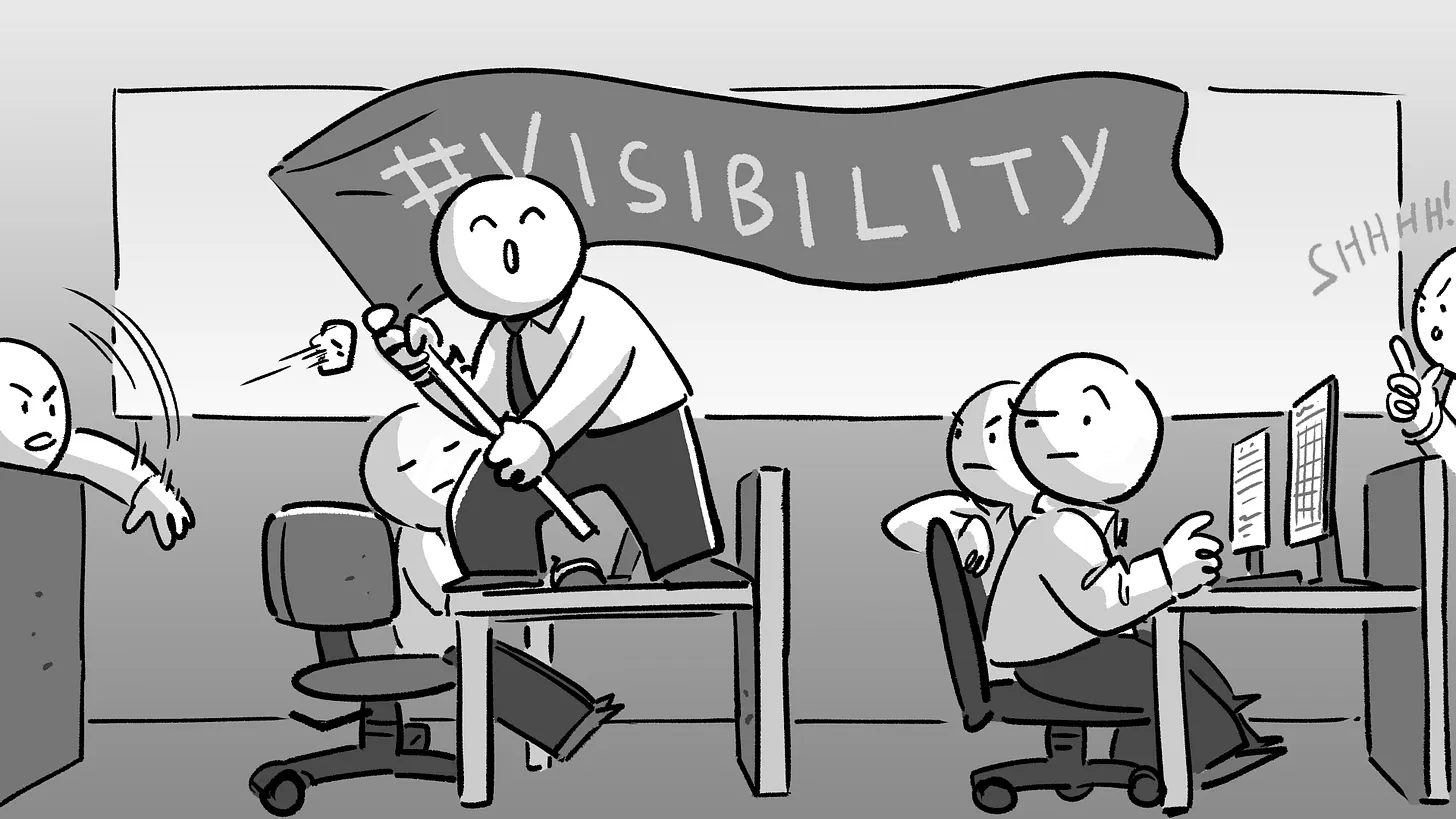
Many capable professionals associate visibility with self-promotion. They do not want to constantly talk about their achievements, dominate meetings, or draw attention to themselves. So they take the opposite approach. They focus on delivering strong work and assume that the right people will eventually notice.
Sometimes they do.
Often, they do not have enough context to understand what they are seeing.
Visibility is not the same as attention
The common idea of visibility is that you need to be seen more.
A more useful definition is that your contribution needs to be understood more clearly.
Consider two professionals who deliver equally strong work.
One regularly communicates what they are working on, why it matters, what they have learned, and where they see a wider implication. The other quietly delivers and moves on to the next task.
The second person may be just as capable. The difference is that the first person is giving others more information about how they think and operate.
That distinction becomes increasingly important as responsibility grows.
When someone is considering you for broader scope, they are not only asking whether you can complete your current responsibilities. They are also looking for evidence of judgment, perspective, influence, and an ability to connect your work to wider priorities.
You cannot demonstrate those qualities if people only see the finished task.
The shift from reporting work to interpreting it
One of the simplest ways to improve professional visibility is to change how you communicate progress.
A traditional update might sound like:
“The project is on track and we completed the first phase.”
A more senior-level contribution might be:
“The first phase is complete. The main issue we identified is likely to affect the next stage, so I recommend we address it now rather than carry the risk forward.”
The second statement does more than report activity.
It shows awareness of implications and willingness to exercise judgment.
That is the kind of visibility that supports career progression because it gives others evidence of how you think.
The same principle applies in performance discussions, stakeholder conversations and meetings where decisions are being shaped.
Instead of only describing what you did, explain what you noticed, what it means, and what you recommend.
You do not need to manufacture visibility
There is another important distinction.
You do not need to turn every achievement into an announcement.
Instead, look for moments where your existing work provides a natural reason to contribute a perspective.
If you solved a recurring problem, explain what you learned from it.
If you identified a risk, explain why it matters.
If you improved a process, connect the improvement to the wider outcome.
If you are seeing a pattern across several pieces of work, raise the pattern rather than keeping each observation isolated.
This makes visibility a by-product of useful contribution rather than a separate exercise in personal promotion.
The people around you cannot read the full story
One reason capable professionals can become frustrated with recognition is that they know the full context of their contribution.
They remember the difficult decision, the stakeholder they influenced, the problem they prevented, and the additional responsibility they quietly absorbed.
Other people may only see the final result.
That is not necessarily a failure of recognition. It is often a communication gap.
Professional credibility grows when you make the relevant parts of that story easier to see.
This does not mean exaggerating your contribution. It means giving appropriate context.
For example:
Instead of:
“I handled the issue.”
Consider:
“I took ownership of the issue, brought the relevant teams together, and changed the approach so we could resolve it without delaying the wider work.”
The second version makes the scope of contribution clearer without becoming promotional.
Visibility should point toward readiness
The strongest visibility is not retrospective.
It also demonstrates how you are beginning to operate at the next level.
That might mean raising a dependency before it becomes a problem, connecting two teams that are working toward the same outcome, challenging an assumption constructively, or offering a recommendation when the situation is ambiguous.
These behaviors communicate something important:
You are not simply completing responsibilities. You are developing the perspective required to carry greater responsibility.
That is a much more useful foundation for career progression than simply becoming more visible.
What This Means in Practice
In performance discussions, promotion conversations, stakeholder interactions, and everyday visibility moments, look for opportunities to make your judgment and impact clearer without turning the conversation into a personal sales pitch. The objective is to help others understand not only what you deliver, but how you think and where you are capable of contributing next.
- Stop assuming strong work will always speak for itself. Add concise context about the problem, your contribution, and the resulting impact when the work is discussed.
- Prepare for performance and progression conversations with evidence of judgment, not just activity. Bring examples of decisions you influenced, risks you identified, problems you reframed, or responsibilities you took beyond your normal remit.
- Change the way you give updates. Move beyond status reporting by including what you are noticing, why it matters, and what you recommend.
- Initiate more purposeful conversations with stakeholders. When you notice a pattern, dependency, or emerging issue, raise it with the people who can act on the insight rather than keeping it within your own role.
- Look for opportunities to demonstrate next-level thinking before you formally have next-level responsibility. This might involve connecting priorities, anticipating consequences, or making a well-reasoned recommendation when there is no obvious answer.
Visibility does not require becoming someone who constantly promotes themselves.
It requires becoming someone whose contribution, judgment, and potential are increasingly easy to understand.
That is a more sustainable form of professional visibility, and one that can support readiness for greater trust and scope.
The goal is not to become louder.
It is to make your contribution, judgment, and readiness clearer to the people who need to see them.
Where might your work already demonstrate more capability than others can currently see?
If visibility feels uncomfortable, you do not have to figure it out alone. A Laser Communication Coaching Session can help you prepare what to say and how to communicate your value authentically in an important presentation, meeting, or 1:1. For more ongoing support, Career Challenge Coaching offers four sessions at regular intervals, giving you space to work through communication challenges, strengthen your approach, and build progress over time.