
How to Ace a Competency-Based Interview for the Irish Civil or Public Service
Competency-based interviews can feel particularly difficult. They are often quite formal; there can be a lot riding on the outcome, and in some cases, you may even know people on the panel or have colleagues aware you are going for the role.
On top of that, you are expected to structure your answers using the STAR method, which does not always come naturally. For many people, especially those who are not used to talking about themselves, this can feel uncomfortable and can impact how clearly they present their experience.
The good news is that this format, more than almost any other type of interview, rewards preparation. Because the structure is predictable and the competencies are published in advance, you can walk in with a clear plan. This guide will show you exactly how.
What is a competency-based interview?
Competency-based interviews are the standard format used by the Public Appointments Service (PAS) and most Irish public sector bodies. Unlike traditional interviews, they are structured, scored, and designed to assess specific behaviours, which means preparation is everything.
A competency-based interview asks you to draw on real past experiences to demonstrate key skills and behaviours. Rather than asking “Are you a good communicator?”, the interviewer will ask “Tell me about a time you had to communicate complex information to a non-expert audience.” Your answer is then scored against a defined competency framework.
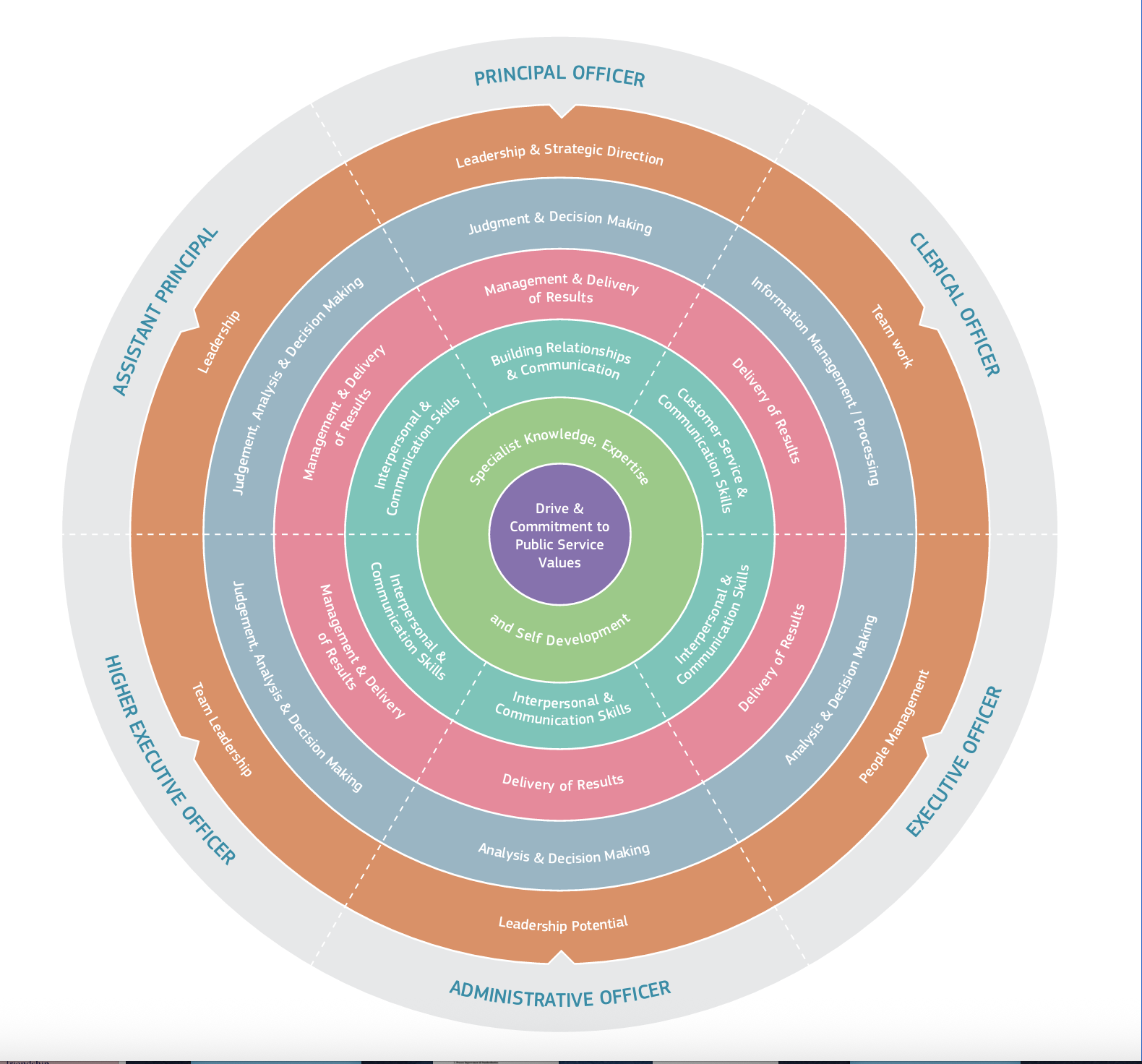
In Ireland, the Public Appointments Service (PAS) uses the Civil Service Competency Framework, which defines the skills and behaviours expected at each grade level — from Clerical Officer right up to Principal Officer and beyond. Many semi-state bodies, local authorities, and HSE roles use equivalent frameworks.
The core competencies you’ll be assessed on
While the exact competencies vary by role and grade, the most commonly assessed areas are:
| Competency | What interviewers are looking for |
|---|---|
| Delivery of results | Planning, prioritising, and completing tasks to a high standard under pressure |
| Interpersonal & communication skills | Listening actively, adapting communication style, building relationships |
| Analysis & decision making | Gathering evidence, weighing options, taking sound decisions |
| Leadership & managing change | Motivating others, managing uncertainty, driving improvement |
| Specialist knowledge & expertise | Role-specific technical skills and relevant qualifications |
| Drive & commitment to public service values | Integrity, accountability, commitment to the public interest |
The STAR method: your answer framework
Every answer in a competency interview should be structured using the STAR method. This keeps your response clear, evidence-based, and easy for the panel to score.
SituationSet the scene briefly. Where were you? What was the context?
TaskWhat was your specific responsibility, challenge or opportunity?
ActionAt least three things you personally did that are relevant to the competency requirements. Be specific; this is the core of your answer and demonstrates your knowledge and exposure.
ResultWhat was the outcome? Quantify it where possible.
Common mistakeCandidates often give too much detail or not enough detail. Be clear on what the main facts are related to the story of relevance, given the role sought and competency criteria. Try to get your answers down to three minutes, aim for 10% of time when describing the context, 10% your task, 60% action, and 20% result.
Key resource
Review the relevant competency framework, such as the Civil Service Competency Framework from publicjobs. i.e., as it will flag post what candidates should speak to when sharing their competency stories, in particular, in the action section.
How to prepare your examples
The most effective way to prepare is to build a personal “evidence bank” — a set of 6–8 strong examples from your work and life experience, each mapped to one or more competencies. Good examples tend to involve challenges overcome and key achievements.
Step 1 — Read the competency framework carefully
Each competency has behavioural indicators at different levels. Make sure you understand what “good” looks like at the grade you’re applying for. A Higher Executive Officer panel will expect more strategic examples than a Clerical Officer panel.
Step 2 — Audit your experience
Look back over the past three to five years. Identify projects, decisions, or challenges that genuinely tested you.
Step 3 — Write out your answers in STAR format
Write a full STAR answer for each example. Aim for answers that take around two to three minutes to deliver out loud. Bullet points are fine for your notes, but the delivery should sound natural and conversational, not read from a script.
Step 4 — Practise out loud
Reading answers silently is not the same as speaking them under interview conditions. Record yourself on your phone, practise with a friend. Work with an interview skills trainer who specialises in public and civil service interviews, as they will support you to identify your best stories and to strengthen them. You want the examples to feel natural, not rehearsed word-for-word.
On the day: what to expect
PAS interviews typically involve a panel of two or three people. Each panel member will ask questions tied to specific competencies, and your responses will be scored independently. The format is standardised; every candidate at that grade is asked the same questions in the same order, so there is no “easier” panel.
- Arrive 10 minutes early; allow extra time if attending in person
- Bring a copy of your application form and any notes you want to review beforehand
- Listen carefully. If you don’t understand a question, ask them to rephrase it
- At the end, you’ll usually be asked if you have any questions; have at least one ready to show genuine interest
Frequently asked questions
Can I use examples from outside paid work?
Yes, particularly for junior grades. Volunteering and community involvement can be useful to share as it can show team leadership and achieving results. What matters is that the example is real and that you can clearly articulate your personal role in it. Ideally, the majority of your examples should come from your work experience.
How long should each answer be?
Aim for two to three minutes per answer. Any shorter and you risk not providing enough evidence; any longer and you risk losing the panel’s attention or running over time. Panels in PAS interviews are generally on a tight schedule and will cut you off mid-story if you are taking too long.
Will they ask follow-up questions?
Yes. Panels are trained to probe with follow-ups like “Why did you choose that solution?” or “Did you have any pushback?” They are common and provide an opportunity to add more evidence. Don’t be unsettled by them.
What if I haven’t held a management role?
For grades that include a leadership competency, you don’t need to have managed a team. Leading a project, mentoring a colleague, or taking initiative in a group setting all count as leadership evidence. Focus on influence and initiative rather than formal authority.
A final thought before your interview
The candidates who perform best are not always the most experienced. They are the ones who have taken the time to understand what the role requires and can clearly show how they meet those needs. If you prepare your examples properly and practise how you deliver them, you will already be ahead of most candidates.
A competency-based interview is also quite an unusual experience. Most people will only go through this type of process a handful of times in their career, often when there is a lot at stake, and the competition is strong.
That is why many candidates choose to get support with their preparation. Not because they are not capable, but because it’s a challenging process. As one client put it after working with me ahead of a public sector competency-based interview: “I’d struggled with the competency format in the past, and Patricia really helped me get my head around how best to approach it… I ended up placing No. 1 on the panel.”
Why work with me
I’m Patricia Tiernan, founder of Leap Coaching and an Accredited Master Coach (Association for Coaching). Before founding Leap Coaching, career highlights include project managing the recruitment of several new departments at Apple’s EMEA headquarters to support the launch of the first iPhone into the European market, as their EMEA Talent Acquisition Specialist. I also worked as an HR Executive for director Peter Jackson’s award-winning post-production film company, Park Road Post, in New Zealand.
For over 14 years, I’ve helped candidates across the civil and public service prepare for interviews at every grade, from entry level to senior management, and many have gone on to place first on their panel. So I understand competency frameworks from both sides of the table. You can read more of their experiences on the testimonials page.
Let me help you walk out of your interview with your head held high
If you have a competency-based interview coming up, explore the interview skills training option that matches your level, and let’s get you fully prepared to perform at your best on the day:
Please feel free to contact Patricia if you have any questions.
Email: patricia@leapcoaching.ie
Phone: +353 (87) 3221548
LinkedIn: linkedin.com/in/patriciatiernan